

Increasing Mushroom Yield with a Monotub
How Do You Increase Volume with a Mushroom Monotub? Quick Answer
Increasing monotub yield comes down to five interlocking variables: tub size, substrate depth, spawn ratio, fresh air exchange, and moisture management between flushes. For UK gourmet staples like oyster mushrooms and lion's mane, targeting 7.5–12.5cm substrate depth, a 1:2 to 1:3 spawn-to-bulk ratio, and 85–95% relative humidity consistently outperforms single-variable tweaks. British homes typically sit at 17–19°C outside summer — too cool for pink oyster, but well within range for lion's mane and blue oyster. Eliminating dead zones, preventing side pinning, and rehydrating properly between flushes lets cumulative yield across multiple harvests compound significantly, separating consistently productive monotubs from those that disappoint after a promising first flush.
Tub Size, Substrate Depth, and Spawn Ratio
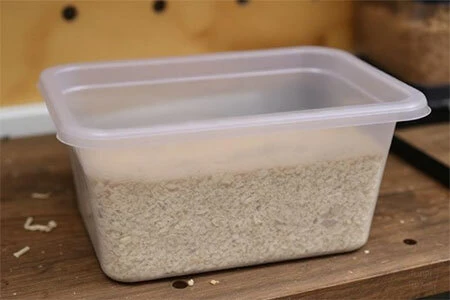
The internal volume of your tub is the hard ceiling that every other optimisation bumps against. More substrate mass means more mycelial network, more moisture reserves, and more fruiting surface area. You simply cannot compensate for an undersized tub with clever technique alone.
Storage boxes from local garden centres or hardware stores work well: look for options in the 50–80 litre range for serious output. A 64-litre box gives you roughly the same interior footprint as the popular 66-quart US Sterilite tubs used in most American guides. There is an additional UK-specific benefit to running larger tubs. British homes are cooler, particularly from October through April, and a larger thermal mass retains ambient warmth more effectively and buffers overnight temperature drops in unheated rooms.
Most gourmet species colonise best at 21–27°C, and the most reliable way to hold that range in a British home is to warm the ambient air rather than the substrate itself. An airing cupboard next to the boiler is the simplest and most stable option, typically holding a consistent 22–26°C with no additional equipment. Where that is not practical, an insulated cupboard warmed by a low-wattage tubular heater on a plug-in thermostat controller, or a small oil-filled radiator on a stat, both heat the air uniformly and hold temperature within a degree or two of your target. Direct-contact heat mats sit under the tub and warm the substrate at the base rather than the surrounding air, which bakes the lower mycelium, drives moisture out of the block, and creates a temperature gradient across the substrate that undermines even colonisation. Current gourmet practice avoids heat mats for bulk substrate work in favour of ambient-air methods that heat the whole grow space evenly.
Substrate depth matters just as much as floor area. Most modern monotub guides target 3–5 inches (7.5–12.5 cm) of packed substrate, which balances moisture reserves against oxygen penetration to the lower mycelium. Anything shallower than 8 cm limits moisture reserves noticeably and typically produces fewer flushes and lower volume per harvest. Going deeper than 12.5 cm is possible and can extend flush count for growers who dunk rigorously between flushes, but it also increases the risk of anaerobic pockets developing in the lower layers if the substrate is even slightly over-hydrated at pack time.
Spawn ratio is the proportion of grain spawn to bulk substrate. Growers running oyster mushrooms or lion's mane on straw or supplemented hardwood sawdust, current modern practice sits at 1:2 to 1:3 spawn to bulk (25–33% grain by weight), with 1:2 recommended for beginners and anyone working outside a still-air environment. At 1:2, colonisation is vigorous enough to outcompete contaminants and produces a denser mycelial network that tends to pin more uniformly. At 1:3, you stretch your spawn further but colonisation runs slower and the contamination window widens. Under-spawning is the more dangerous error, particularly in the UK's variable spring and autumn temperatures when ambient humidity fluctuates. A well-inoculated, evenly mixed substrate colonises uniformly, produces consistent first-flush volume, and retains enough nutritional reserves for second and third harvests.
To make these numbers concrete for planning and shopping purposes, the table below matches grain and substrate quantities to three commonly used monotub sizes. All three run a 1:2 grain-to-substrate ratio (roughly 33% grain by weight), which sits at the vigorous end of the range recommended above and suits growers working without a flow hood.
|
Tub Size |
Volume |
Internal Dimensions |
Grain Spawn |
CVG Substrate |
Ratio |
|---|---|---|---|---|---|
|
Small |
~28 L (30 qt) |
30.5 × 30.5 × 30.5 cm |
1 kg |
2 kg |
1:2 |
|
Medium |
~53 L (56 qt) |
45.7 × 38.1 × 30.5 cm |
1.5 kg |
3 kg |
1:2 |
|
Large |
~69 L (73 qt) |
57.2 × 39.4 × 30.5 cm |
2 kg |
4 kg |
1:2 |
For custom or non-branded tubs, the same principles carry across: measure your tub's footprint and target depth, work out the finished substrate volume in litres, and apply the 1:2 ratio to split it into grain and CVG by weight. Beginner growers benefit from starting with the small size, which is easier to manage for pack density, moisture, and airflow. Medium and large tubs give bigger harvests but demand tighter control of the five core variables.
Optimising Fresh Air Exchange to Drive Pin Density and Prevent CO₂ Buildup
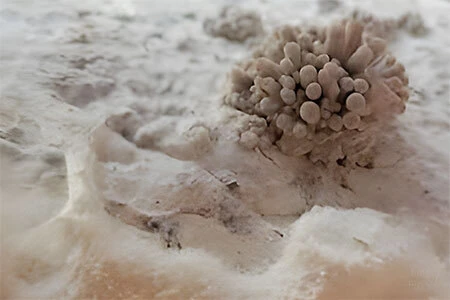
CO₂ is heavier than oxygen and sinks. In a sealed tub, it accumulates at the substrate surface exactly where you need fresh air the most. Paul Stamets in Growing Gourmet and Medicinal Mushrooms sets the target CO₂ ceiling for pin initiation at 500–1000 ppm for oyster and 500–700 ppm for lion's mane [1]. Above roughly 1000 ppm, pin initiation is suppressed. The mushrooms that do form grow tall and thin as they reach upward for oxygen, producing low-density fruiting bodies with reduced harvest weight.
Fresh air exchange (FAE) removes stale CO₂ and replaces it with oxygen-rich air. Stamets' parameters call for 5–8 fresh air exchanges per hour during pinning and fruiting for both species. Three practical methods cover most setups [1].
Adding or removing layers of tape gives precise, reversible control over airflow, filter discs offer a consistent pre-set airflow rate straight from the packet, and polyfill lets you vary density by how tightly you pack it. Manual fanning with a lid or tray twice daily is a step up in effort but costs nothing. A small USB fan on a 15-minute-on, 45-minute-off timer is the most hands-off solution and works well in a spare room or tent
.Hole placement matters more than hole count. Placing holes at both high and low points on the tub walls exploits natural convection: fresh air enters low, spent air exits high. Six holes in total, four near substrate level and two near the lid, is a common starting configuration.
Both oyster and lion's mane are genuinely CO₂-sensitive at the fruiting stage, and the difference between them is smaller than older guides sometimes suggest. Lion's mane in particular produces its characteristic elongated, coral-like or antler-shaped malformation when FAE is inadequate, and this is one of the most frequently misdiagnosed cultivation problems. If your lion's mane is producing stringy, ropy growth rather than the expected compact pom-pom, the fix is almost always more airflow, not less.
One practical note for the UK climate: in cooler homes, aggressive FAE can drop tub temperature below the pinning threshold, particularly for species like blue oyster that are already comfortable at 13–18°C. Monitor ambient temperature alongside humidity. A simple digital thermometer alongside your hygrometer keeps both variables visible..
Moisture, Rehydration, and Maximising Flush Count
A dry top layer kills volume quietly, and it is one of the most common reasons a fully colonised substrate underperforms. Pin initiation depends on surface humidity, and when the top layer dries out, the moisture gradient that triggers pinning collapses and the flush produces sparse, stunted fruiting bodies. The target relative humidity for oyster mushrooms at fruiting is 85–90% [1] and for lion's mane 85–95%. A cheap digital hygrometer placed inside the tub gives you a real number to manage against.
Misting correctly means light and even. A fine spray across the substrate surface twice daily is sufficient. Over-misting causes pooling water on the surface, creating anaerobic pockets that invite bacterial contamination. Watch the lid: light, even condensation across the underside indicates healthy humidity, while a dry lid means mist and check your FAE balance. Unlike button mushrooms (Agaricus) and cubensis grows, oyster and lion's mane monotubs are not typically cased with a peat and hydrated lime layer. Casing is standard practice for those species but has no established benefit for gourmet monotub grows, and the effort is better spent on FAE tuning and surface humidity management.
Fruiting bodies are over 90% water [2], and every flush pulls significant moisture from the substrate. Dunking, which means removing the substrate block and submerging it in cold water for 12–24 hours, is the standard method for deep rehydration between flushes. Bottom watering allows gradual absorption from below without disturbing surface mycelium and is a good alternative if the block is fragile or has fruited from the sides. Surface misting alone is insufficient as a primary rehydration method between flushes.
Oyster mushrooms reliably produce two to four flushes from a well-maintained monotub, with the first two being the strongest. Lion's mane typically gives two to three flushes, again with the first providing the bulk of the harvest weight. Stamets notes 7–10 days between crops for oyster as a working figure [1], and modern practice with rigorous dunking often stretches useful flush count beyond his conservative two-crop baseline. Watch for pin primordia before reintroducing fruiting conditions after the rest period. Wrapping clear tubs in black polythene eliminates side pinning caused by ambient light reaching mycelium through translucent walls.
FAQs
Focus on five variables: substrate depth (7.5–12.5 cm), a 1:2 to 1:3 spawn-to-bulk ratio, consistent fresh air exchange, humidity of 85–95%, and proper rehydration between flushes. Eliminating dead zones and preventing side pinning also recover volume that would otherwise be lost. Addressing all five together produces the most significant cumulative improvement across multiple flushes.
For most gourmet species grown in the UK, aim for 7.5–12.5 cm (3–5 inches) of substrate depth. Deeper beds retain moisture longer and tend to produce stronger consecutive flushes, provided the substrate is not over-hydrated at pack time. Going shallower than 8 cm limits moisture reserves and reduces overall flush count noticeably.
Without adequate FAE, CO₂ accumulates inside the tub and suppresses pinning. Paul Stamets specifies 5–8 fresh air exchanges per hour and CO₂ kept below 1000 ppm for both oyster and lion's mane during pin initiation and fruiting [1]. Lion's mane in particular is highly CO₂-sensitive and produces its characteristic elongated, coral-like malformation when FAE is inadequate. Filtered holes with micropore tape, filter discs, or polyfill; manual fanning; or a small timer-controlled fan will all deliver adequate exchange when tuned to your setup.
With proper rehydration and care, oyster mushrooms typically yield two to four flushes from a well-maintained monotub, with the first two providing the strongest harvests. Lion's mane usually produces two to three flushes. Flush volume tends to decline noticeably after the second harvest as substrate nutrients are exhausted. Dunking the block in cold water for 12–24 hours between flushes is the single most effective way to extend flush count.
Side pinning is caused by light reaching the mycelium through translucent tub walls. Use opaque tubs, or wrap clear tubs in black polythene or cardboard to block light entirely. Fitting a polythene liner inside the tub also creates a light barrier along the walls and allows bottom watering, redirecting pins to the top surface where they are harvestable.
- Paul Stamets, Growing Gourmet and Medicinal Mushrooms, 3rd edition, Ten Speed Press, 2000. ISBN 978-1580081757.
- Hennessy, N. — Ten water-rich foods to help you stay hydrated. Available at: https://www.bupa.co.uk/newsroom/ourviews/ten-water-rich-foods-hydration (Accessed 15 August 2025).