

Choosing Mushroom Spores for Microscopy
How to Choose Mushroom Spores for Microscopy: Quick Answer
Choosing spores for microscopy comes down to sample quality, species suitability, and sourcing. A good sample is fresh, densely printed, and clearly labelled with species and collection date. Beginners typically start with species that have dense, dark, well-documented spores — magic mushroom spores are a common choice in the UK, as spores contain no psilocybin and remain legal to buy, sell, and study. Comparing spore colour, shape, and size helps with identification, while sourcing from reputable, transparent vendors ensures reliable results. Building a shortlist across a few species, rather than buying at random, supports long-term, consistent research practice.
What Makes a Spore Sample "Good" for Microscopy?
Not every print earns its place on a slide. When starting out I threw away many a sample, and it took a while to work out why some of them never gave me anything worth looking at, no matter how carefully I mounted them.
Freshness is paramount, and it matters more than most people expect. Spores degrade. A print left sitting in a drawer, a spore syringe not stored in the fridge. These can look muddy and indistinct once you actually get it under magnification, even if they seemed perfectly fine to the naked eye at the time. Density comes a close second. Too thin a print and you'll spend twenty minutes hunting across the slide for a single usable spore. Too thick, and they clump together, hiding exactly the detail you're trying to observe. There's a middle ground, and it only really comes with practice.
Then there's the print itself — how it was actually made. Was it collected somewhere clean, away from draughts and dust? On the right paper, dark-and-light split so nothing's lost against the background? A rushed or careless print rarely redeems itself later, no matter how good the microscope you're pointing at it.
Beyond the physical sample, there's a documentation side worth mentioning too, even briefly. A sample paired with clear species information, a collection date, and ideally some reference imagery gives you something to actually cross-check against. Without that context, a print is just a curiosity sitting in a vial. With it, it becomes something closer to a proper research sample — the kind you can genuinely learn from, not just look at once and forget.
Why Magic Mushroom Spores Are a Popular Starting Point
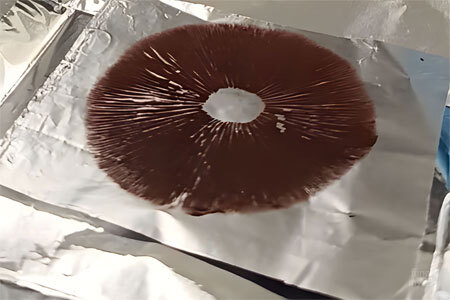
Look around any UK mycology forum and psilocybe cubensis species (a type of magic mushroom spores) comes up regularly as a solid first sample. There are a few honest reasons for that, and not all of them are about ease.
Legally, they're a sensible entry point. Spores contain no psilocybin, so possessing and studying them sits outside the Misuse of Drugs Act entirely — right up until germination begins [1]. That's not a technicality people are stretching to justify a hobby; it's simply how the legislation is written, and it means beginners can practise without wading into anything legally murky. Worth reading the fuller legal breakdown if you want the specifics, but the short version holds up.
Practically speaking, they're also just well suited to learning on. The prints tend to be dense and dark, easy to see clearly, easy to work with under lower magnification while you're still building basic slide technique and getting your eye in. Nobody wants to start on a species where the spores are pale and barely visible — that's a recipe for frustration in week one.
And because magic mushroom spores are so widely studied, there's an unusually large body of reference material and community knowledge to compare your own observations against. Forums, published morphology data, photos from other hobbyists — all of it exists in volume for this species in a way rarer, less-documented fungi simply can't offer a beginner. None of that makes them the "correct" choice forever, mind. It just makes them a sensible, well-supported place to start before branching out.
Comparing Spore Characteristics Across Common Species
Most people who have never looked at a spore through a microscope don't consider that spores are not interchangeable. Colour is the first thing anyone notices — deep purple-brown, rusty orange, pale cream, even white — and it's often the fastest clue to what you're looking at.
Shape takes longer to appreciate. Some spores are smooth ellipsoids, almost featureless at lower magnification. Others carry ornamentation — ridges, warts, subtle texturing on the wall — that only reveals itself once you're pushing higher magnification with decent lighting [2]. I mistook an ornamented spore for a dirty lens the first time I saw one; took a second sample to realise the texture was the whole point, not a smear on the glass.
Size varies more than beginners expect, and it's measured properly in micrometres rather than eyeballed against a mental average. Two species can look near-identical at a glance and turn out to differ meaningfully once you're actually measuring. That's part of why leaning on a single feature — just colour, or just shape — tends to mislead. Even loose identification usually needs two or three characteristics agreeing with each other before it means much [3].
None of this is about memorising a fixed set of features either. It's about training your eye, sample after sample, until differences that once needed hunting for start announcing themselves on their own.
Beginner-Friendly vs Advanced Species: What to Choose First
There's a temptation early on to go straight for the species everyone talks about online — the rare one, the visually striking one, the one with the interesting forum thread attached. Resist that for a session or two. It usually backfires.
The real difference isn't visibility so much as how forgiving a species is technically. Some react predictably and clearly to standard reagents like Melzer's, giving you a clean amyloid or non-amyloid result you can actually trust while you're still learning to interpret colour changes. Others react ambiguously, or need staining technique you haven't built yet, which just muddies an already difficult skill to learn.
Advanced species also tend to demand more precision before you've earned it — finer focus control, steadier hands with the coverslip, sometimes oil immersion from the very first slide rather than working up to it gradually. That's a lot to ask of someone still getting used to basic mounting. I jumped ahead once, keen to identify something rarer, and spent an entire evening convinced my microscope was faulty. It wasn't. I just wasn't ready to interpret what I was looking at yet.
Sourcing Spores Responsibly
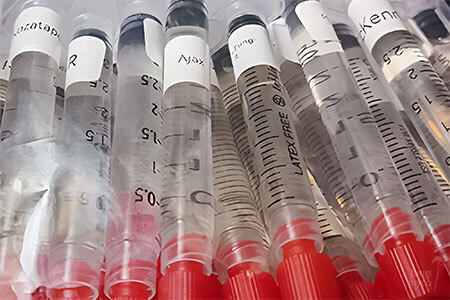
In case you missed it — sourcing spores is a task that requires your undivided attention. You can have a study space with all the equipment, the environment, the setup, even the know-how but it won't mean anything without a reliable source of spores.
And no not all vendors are equal, and this is one area where cutting corners actually costs you later, not just at checkout. I bought from a cheap, unlabelled listing early on (no names) — no species confirmation, no batch date, nothing — and spent weeks assuming I'd mishandled a sample that was probably just contaminated or mislabelled from the start. Impossible to know, really. A bad source doesn't just risk a poor sample; it removes your ability to trust anything you observe from it afterward.
A responsible vendor labels clearly — species name, collection or packaging date, sometimes even parent strain information if it's relevant to what you're studying. That level of detail matters more than price, and considerably more than flashy packaging. Reviews and community reputation are worth checking too, but be wary that almost all vendors actively reward reviews — meaning that they are not impartial and therefore less reliable.
Storage conditions before it reaches you matter as well, though it's easy to overlook. Spores held somewhere warm or damp before shipping can degrade before you've even opened the packet, and careful handling on your end won't undo that. Ask, if it's not stated outright — a vendor confident in their process won't mind explaining it.
We provide 65+ magic mushroom spores for microscopy. Carefully sterilised in an ISO 5 rated clean air environment, are prepared only when ordered and are regularly tested for viability. See the reviews — unincentivised so that you know that they are real.
Building a Species Shortlist for Long-Term Study

Buying whatever looks interesting is fun for a while. Eventually, though, it just leaves you with a drawer full of half-remembered vials and no thread connecting any of them. A shortlist fixes that, and it really doesn't need to be complicated.
Think in terms of purpose rather than just preference. A few species chosen because they're technically forgiving, one or two chosen because they push you toward a skill you haven't built yet, maybe one chosen purely because the morphology genuinely interests you. That mix keeps things moving without turning study into a chore or a random grab-bag.
Revisiting the same species over months, rather than always chasing something new, is underrated too. Samples vary batch to batch, and returning to a familiar species with a slightly sharper eye than last time tends to teach you more than another unfamiliar one would. Less exciting, admittedly. But it's where the real competence quietly builds.
A shortlist also gives future sessions somewhere to start. Instead of standing in front of a vendor site wondering what to buy next, you've already got direction — and that's really what turns an occasional hobby into something closer to an actual practice.
Frequently Asked Questions
Species with dense, dark, well-documented spore prints tend to be easiest for beginners — they're simple to see clearly and there's plenty of reference material to compare against. Magic mushroom spores are a common starting point for exactly this reason, alongside being straightforward to source legally in the UK.
Yes. Spores themselves are legal to buy and sell in the UK, since they don't contain psilocybin. Stick to vendors who label samples clearly with species and collection date — that matters more for your research than price.
It varies by species and storage conditions, but a well-stored print in a cool, dry, sealed vial can remain usable for months to years. Poor storage — heat, moisture, light exposure — shortens that considerably, sometimes to just weeks.
Yes, significantly. Colour ranges from deep purple-brown to rust, cream, or white, and shape varies from smooth ellipsoids to ornamented, textured walls. These differences are often the first clues used in identification
Both work for microscopy purposes, though prints are generally easier to store, label, and reference long-term. Syringes are a liquid suspension and can be more prone to contamination if not stored properly.
Look for a dense, evenly distributed print with clear labelling — species name, collection date, and ideally vendor reputation you can verify. A fresh, well-documented sample will consistently outperform an older or unlabelled one under the microscope.
- UK Government — Misuse of Drugs Act 1971. Available at: https://www.legislation.gov.uk/ukpga/1971/38/contents (Accessed 23 April 2026).
- Wikipedia — Mushroom. Available at: https://en.wikipedia.org/wiki/Mushroom (Accessed 17 July 2026).
- Singer, R (1986) — The Agaricales in Modern Taxonomy.