

When & How to Harvest Your Mushrooms
When & How to Harvest Your Mushrooms: Quick Answer
Beginners almost always wait too long to harvest their mushrooms. Mushrooms tell you when they're ready — you just need to learn the signs. Most gilled species are best picked when the caps are half to two-thirds open, edges still curled under, before any spore dust appears below. Oyster clusters twist off whole at the base; shiitake are better cut with a clean blade. The window is short — often just a day or two — so a quick daily check matters once pins start forming. I've lost plenty of flushes by leaving them an extra day. The rest of this guide goes species by species from here. Not sure about a particular one? Get in touch.
Why Harvest Timing Matters More Than Mushroom Size
It is tempting, especially on a first grow, to wait until the mushrooms look a good size before picking. It feels like the cautious choice. It usually is not. Size tells you very little about whether a mushroom is at its best — a cap can still be growing and already past the point where its texture and flavour peak.
What matters instead is a small set of physical signals: how far the cap has opened, whether its edge is still rolled under, the state of the veil on species that have one, and whether the mushroom has begun to shed spores. Reading those is the real skill, and it comes quickly once you know where to look.
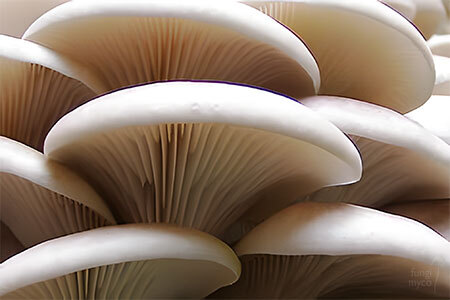
It helps to think of harvesting as a window rather than a single moment. There is a stage where the mushroom has put its energy into the fruiting body but has not yet shifted into spreading spores — that is when it is firmest and best for the kitchen. Leave it beyond that point and it begins to spend itself on reproduction instead: the texture softens, the flavour thins, and the shelf life shortens [1].
That window is genuinely short. In a warm room it can pass within a day, which is why the most useful habit you can build is a brief daily check once pinning begins. It takes seconds, and it is the difference between a good flush and a disappointing one.
Growing in the UK offers a modest advantage here, worth knowing rather than overstating. Most homes have cooler spaces than the warm, stable conditions many growing guides assume — a shed, a garage, an unheated spare room. Cooler air slows the progress from pin to mature mushroom, which widens the harvest window a little and makes the daily check more forgiving. It does not remove the need for it.
How to Read the Signs That Your Mushrooms Are Ready
Every species tells you it is ready in its own way. The cues below cover the three grown most often at home, and once you have read a few flushes of each, the judgement becomes quick.
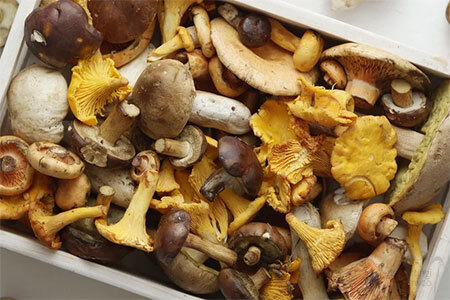
Oyster mushrooms (Pleurotus ostreatus). Pick the cluster when the caps are roughly half to two-thirds open and the edges are still rolled under rather than flattened or turned upward. The gills should be visible but not yet fully exposed. Oysters are early, heavy sporulators, so a fine dust settling on the surface below means you have left it slightly too long. The flesh should feel firm rather than soft.
Shiitake (Lentinula edodes). Here the veil — the thin tissue beneath the cap — is the thing to watch. Harvest while it is still intact or only just starting to tear; once it has pulled fully away from the stem, the mushroom is past its best. The cap should be open but still gently domed, the gills pale rather than darkening.
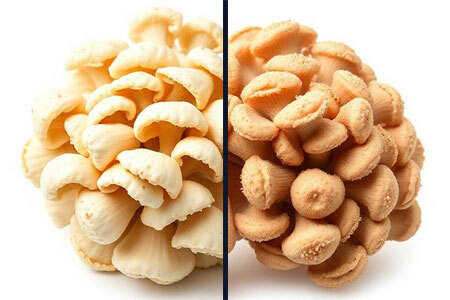
Lion's mane (Hericium erinaceus). There is no cap to read on this one, so the cues differ. Watch the spines: while they are white and the mushroom is firm, it is ready. As it ages the spines lengthen and their tips begin to yellow or brown, and the flavour turns bitter along with them. White and firm is the rule.
Across all three, one signal overrides the rest. If you see spore dust — white, grey or brown — on the surface below the mushrooms, the window has closed. Pick straight away regardless, because a mushroom left to spoil in place causes more trouble than one picked a little late.
Should You Cut or Twist-and-Pull? Harvesting Technique Explained
There is no universal answer to this, and anyone insisting on one is oversimplifying. The right method depends on the species and on what it is growing on.
For oyster mushrooms and other cluster-formers, twisting the whole cluster off at the base is the better approach. Take hold of the base, rotate gently and pull, aiming for a clean removal with no stub left behind. A stub left on the block will rot, and rotting tissue is precisely the warm, damp, nutrient-rich material that competing moulds colonise — a single neglected stub can put a whole block at risk.
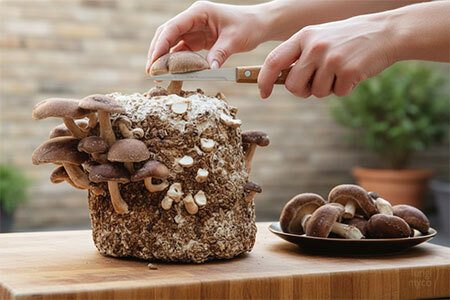
Shiitake grown on a log or hardwood block are a different case. The stem base is often set into the substrate, and pulling risks tearing the surrounding mycelium. A clean cut with a sharp blade, just above the surface, does less damage.
Whichever method a species calls for, keep your hands clean and, if you are using a blade, wipe it down — a quick wipe with isopropyl alcohol is enough. This matters most when you are working across several blocks in one session, where contamination is easily carried from one to the next.
If there is a single mistake worth flagging, it is hesitancy. A half-hearted twist tends to leave half the stub behind, which is the worst of both outcomes. Commit to the movement: a clean, decisive removal beats a careful, incomplete one.
What Happens If You Miss the Harvest Window
It happens to everyone eventually. A weekend away, a busy stretch, and you return to a block that has moved on without you. It is worth knowing what you are looking at and what to do about it.
An over-mature mushroom is not subtle. The caps flatten and lose their curve, the gills darken from pale cream towards grey or brown, and spore dust collects on whatever lies below. The flesh turns from firm to soft or watery, the smell grows stronger, and the already-short shelf life falls away to almost nothing.
For the kitchen, a late-picked mushroom is a poor return — the caps break down in cooking and the flavour is thinner. If you grew your own partly to better what the supermarket offers, this is the stage where that comparison stops flattering you.
The greater cost is to the block itself. A mushroom left to rot in place puts moisture and decaying matter straight onto the substrate surface — ideal conditions for the green, black and pink moulds that bring a flush cycle to an early end. A single rotting stub can spread trouble across an otherwise healthy block within days.
So if you have missed the window, the advice is simple: pick anyway, and pick promptly. A mushroom that has opened out and shed its spores has done its biological job, and there is no benefit in leaving it — onto the compost is far better than left on the block. Then look after what remains. A healthy block will usually fruit again, often several times over; the Royal Horticultural Society's growing guidance says the same. Each flush is a fresh chance to get the timing right [2].
Frequently Asked Questions
Look for caps that have opened to roughly a half or two-thirds, with the edges still curled under, firm flesh, and no spore dust on the surfaces below. Shiitake are best picked before the veil tears fully away from the stem, and lion's mane while its spines are still white and short. Once pinning has begun, check daily — the window is short.
It depends on the species. Oyster mushrooms and other cluster-formers are best twisted off whole at the base, leaving no stub behind to rot. Shiitake growing on logs or blocks are better cut with a clean blade, since pulling can tear the mycelium. Keep hands and blade clean to avoid carrying contamination between blocks.
An over-mature mushroom develops a flat, watery cap, darkening gills and visible spore dust, and both quality and shelf life fall sharply. Left in place, it can rot and seed contamination that shortens the life of the whole block. If you have missed the ideal window, pick promptly rather than leaving it.
A healthy block will usually give more than one flush — commonly two or three, sometimes more, depending on the species and how well it is cared for between crops. Rest the block, clear away any stub or debris, and rehydrate the substrate between flushes. Cooler conditions tend to lengthen the gap between them.
- Wikipedia — Fungiculture. Available at: https://en.wikipedia.org/wiki/Fungiculture (Accessed 16 April 2026).
- RHS — Grow your own mushrooms outdoors. Available at: https://www.rhs.org.uk/biodiversity/grow-your-own-mushrooms-outdoors (Accessed 16 April 2026).